

- Genre:fiction
- Sub-genre:Science Fiction / General
- Language:English
- Series Title:The Source Trilogy
- Series Number:2
- Pages:320
- Paperback ISBN:9798317850487
Book details
Overview
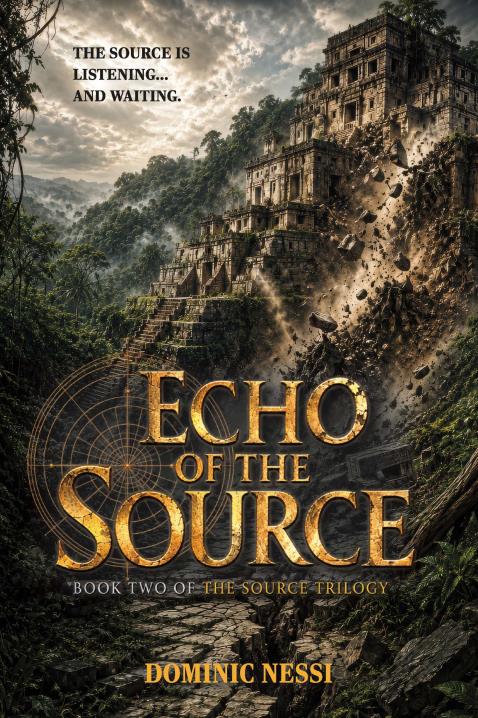
In the aftermath of the discoveries in The Source, a scientific team travels to the ancient Maya city of Toniná, where new evidence suggests the mysterious planetary network remains active. Among them is Chris Whiting, whose connection to the earlier events is more profound than anyone realizes. As earthquakes and unexplained disturbances spread across Mesoamerica, the team races to decipher an ancient codex and understand the network's purpose. Standing against them is Helios, a powerful corporation determined to control what lies beneath Toniná. Echo of the Source expands the mystery into a dangerous struggle over knowledge, power, and Earth's fragile stability.
Read moreDescription
The discovery of the Source changed what humanity understood about its past. But it also revealed something far more unsettling: the ancient planetary network is still active—and its purpose remains only partially understood.
More than a decade after the events that first exposed the Source, questions remain about the civilizations that came before humanity, the extraordinary structures they left behind, and the forces those structures may have been designed to influence. What once appeared to be isolated archaeological mysteries are beginning to look like pieces of something much larger.
When a scientific team from the Mesoamerican Archaeological Research Institute travels to the ancient Maya city of Toniná in southern Mexico, new evidence suggests that the network discovered in The Source extends far beyond the sites already known—and that Mesoamerica may contain another crucial piece of its forgotten history.
Joining the expedition is Chris Whiting, a brilliant young researcher whose connection to the Source is deeply personal. He is the grandson of Christina Whiting, the scientist whose discoveries transformed humanity's understanding of its past. Years later, Chris is still searching for answers about his grandmother, what happened to her, and the extraordinary legacy she left behind.
At Toniná, the team uncovers an ancient codex with implications far beyond the ruins themselves. Patterns begin to emerge among archaeological sites scattered across Mesoamerica. Ancient structures, geological forces, and fragments of knowledge preserved across cultures appear to be connected in ways no one anticipated. The deeper the researchers look, the more difficult it becomes to separate archaeology from geophysics—or the distant past from events unfolding around them.
But the scientists are not working alone.
Helios, a powerful international corporation brought in to work alongside the expedition, possesses technology and resources far beyond those available to the research team. At first, the partnership promises access to sophisticated equipment and data that could accelerate their discoveries. Gradually, however, inconsistencies begin to appear. Scientific information does not match. Equipment is compromised. Critical data is withheld or altered. And the researchers begin to question whether Helios came to Mesoamerica to help understand the ancient network—or to exploit it.
Then the disturbances intensify.
Seismic activity, volcanic unrest, and unexplained anomalies raise a terrifying possibility: whatever the ancient builders created was not merely symbolic, ceremonial, or architectural. The network may interact with the planet itself. And if it can be understood, it may also be manipulated.
As the investigation moves from Mexico into Guatemala, the search for answers leads the team toward the volcanic highlands and Lake Atitlán. What began as an archaeological expedition becomes a struggle to understand a system whose reach may be global—and whose disruption could carry consequences far beyond Mesoamerica.
For Chris, the journey becomes increasingly personal. The closer he comes to understanding the network, the closer he comes to the unanswered questions surrounding Christina. Ancient knowledge, family history, and the mystery of the Source begin to converge, suggesting that his connection to his grandmother's discoveries may be greater than he ever imagined.
From the ancient ruins of Toniná to Guatemala's Lake Atitlán—and ultimately back to Toniná, where the consequences of their discoveries await—Echo of the Source expands the mystery begun in The Source into a struggle over ancient knowledge, scientific discovery, corporate ambition, and the dangerous desire to control forces humanity is only beginning to understand.
Read more