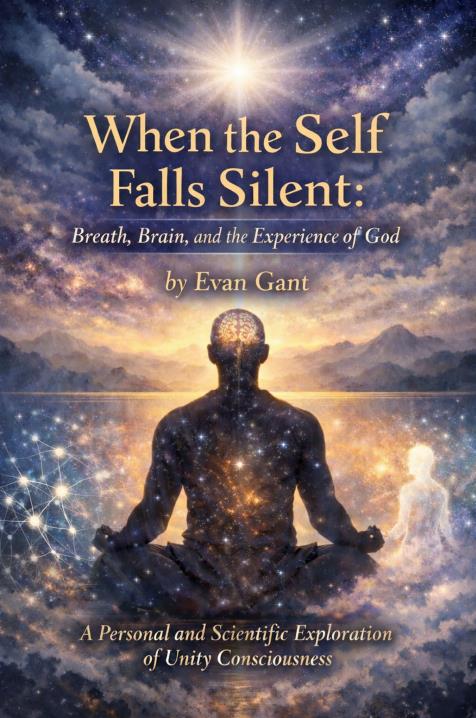


- Genre:psychology
- Sub-genre:Neuropsychology
- Language:English
- Pages:360
- Hardcover ISBN:9798317850043
Book details
Overview
What happens when the endless voice inside the mind finally grows quiet?
For thousands of years, mystics, contemplatives, yogis, saints, and philosophers have described moments in which the ordinary sense of self dissolves, revealing an overwhelming experience of peace, unity, love, and luminous awareness. These transformative events have been called enlightenment, cosmic consciousness, union with God, samadhi, awakening, mystical union, and the Kingdom of Heaven within. Despite differences in language and culture, the descriptions are strikingly similar. They point toward a profound possibility: beneath the constant activity of the thinking mind lies a deeper dimension of consciousness waiting to be discovered.
When the Self Falls Silent is both a deeply personal memoir and an interdisciplinary exploration of one of humanity's oldest questions: What is consciousness, and what happens when the ego falls silent?
Unlike many books that approach spirituality solely through philosophy or religious belief, this work unites personal experience, neuroscience, psychology, contemplative traditions, respiratory physiology, and A Course in Miracles into a coherent investigation of the relationship between the brain, the mind, and transcendent awareness. The result is an accessible yet intellectually rigorous journey that bridges ancient wisdom and modern science without reducing either to the other.
The book begins with an extraordinary autobiographical account.
On August 13, 1983, during an intensive connected-breathing session overlooking the Pacific Ocean in Laguna Beach, California, the author underwent a profound transformative experience unlike anything he had previously encountered through years of meditation and spiritual practice. As breathing gradually became effortless, the ordinary boundaries of self disappeared. Thought ceased. Time vanished. The familiar identity that had defined personal existence dissolved into what could only be described as an infinite field
Read moreDescription
What if the greatest spiritual discovery of your life did not require adopting a new belief, joining
a religion, or accepting someone else's philosophy?
What if it began instead with something profoundly simple:
the quieting of the self?
For millennia, humanity's greatest contemplatives have described extraordinary moments in
which the familiar sense of "I" suddenly dissolves. Across cultures and civilizations they have
spoken of entering states of overwhelming peace, boundless love, radiant light, timeless
awareness, and complete unity with all existence. Hindu sages called it samadhi. Buddhist
masters described awakening. Christian mystics spoke of union with God. Sufi poets celebrated
annihilation of the self in Divine Love. Jewish Kabbalists, Taoist adepts, Gnostic Christians,
indigenous visionaries, and modern contemplatives have each attempted to describe an
experience that seems to transcend language itself.
Despite vast differences in theology, geography, and historical period, their descriptions share
remarkable similarities.
The internal dialogue falls silent.
Fear disappears.
The boundaries separating self and world dissolve.
Time loses its grip.
Love becomes the natural condition of awareness.
A luminous intelligence seems to underlie reality.
For centuries these reports were regarded primarily as religious testimony or mystical poetry.
Today, however, advances in neuroscience, psychology, neurophysiology, respiratory science,
and consciousness research have begun illuminating aspects of these experiences from an
entirely new perspective.
Could ancient contemplative traditions and modern neuroscience be describing different aspects
of the same human potential?
That question lies at the heart of When the Self Falls Silent.
This is not merely another book about meditation.
It is not another book about neuroscience.
Nor is it simply another memoir describing an unusual spiritual experience.
Instead, it is an ambitious interdisciplinary exploration that weaves together autobiography,
contemplative history, neuroscience, psychology, respiratory physiology, philosophy, and A
Course in Miracles into a unified investigation of one of humanity's oldest mysteries:
What happens when the ordinary self becomes quiet?
A Personal Journey Becomes a Lifelong Investigation
Every serious investigation begins with a question.
This one began with an experience.
On August 13, 1983, during an intensive session of connected breathing in a mountainside home
overlooking the Pacific Ocean in Laguna Beach, California, the author's life changed forever.
Years of meditation, yoga, contemplative study, and spiritual searching had prepared the ground,
but nothing anticipated what followed.
As breathing gradually deepened and then mysteriously involuted into effortless stillness, the
ordinary structures of awareness dissolved.
Thought stopped.
Time vanished.
The familiar psychological identity disappeared.
What remained was an indescribable field of radiant white consciousness experienced as infinite
love, overwhelming peace, limitless intelligence, and complete unity.
The experience lasted only minutes.
Its effects have continued for decades.
Many people might have accepted the event as a profound mystical blessing and simply moved
on.
Instead, the author spent more than forty years asking a question that eventually became the
foundation of this book:
Why did this happen?
Could such experiences be understood scientifically without diminishing their spiritual
significance?
Could modern neuroscience help explain what contemplatives have described throughout
history?
Could ancient wisdom traditions preserve remarkably accurate phenomenological maps of
consciousness that contemporary science is only beginning to investigate?
These questions transformed a single experience into a lifelong interdisciplinary investigation.
Science Meets Spiritual Experience
Perhaps the greatest contribution of When the Self Falls Silent is its refusal to force readers i
Read more