

- Genre:business & economics
- Sub-genre:Leadership
- Language:English
- Pages:132
- eBook ISBN:9798317834937
- Paperback ISBN:9798317834920
Book details
Overview
Leadership breakdown rarely begins with strategy. It begins with perception.
Trait-Based Leadership introduces a disciplined framework for understanding how identity shapes interpretation under pressure—and how that interpretation influences energy, decision-making, and culture. Drawing from identity development research, affective neuroscience, and applied leadership theory, this model helps leaders recognize when strengths overextend into distortion and how regulation restores proportion.
For executives, founders, educators, and organizational leaders navigating sustained responsibility, this book offers a clear path: understand your identity, regulate your energy, and design systems that reflect balance rather than amplification.
When identity integrates, perception widens. When perception widens, culture strengthens.
Read moreDescription
Leadership rarely collapses in dramatic fashion. It shifts quietly—often invisibly—in the space between stimulus and response. A question lands differently. Feedback carries weight. Certainty hardens. Energy intensifies. Decisions tighten.
What follows shapes culture.
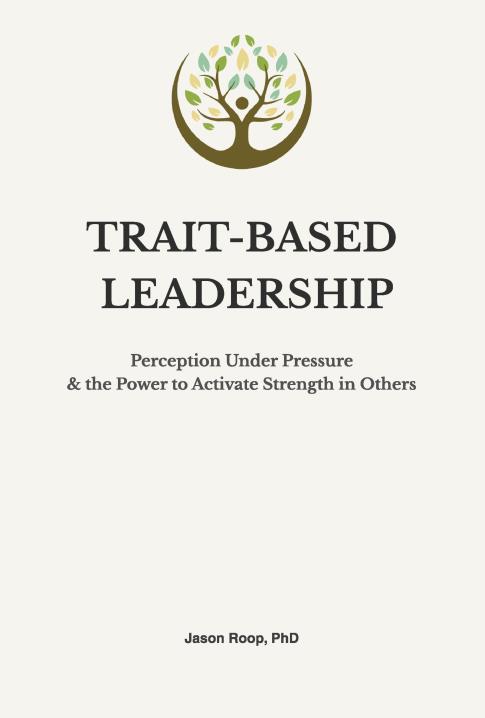
Trait-Based Leadership offers a rigorous, identity-centered framework for understanding how leaders interpret pressure and how that interpretation cascades into tone, structure, and organizational design.
Rather than treating leadership as a performance model focused solely on behavior, this work examines leadership at its source: identity. When identity feels threatened, perception narrows. Narrowed perception intensifies energy. Intensified energy amplifies archetypal posture—Ruler, Champion, Lover, or Enchanter. Over time, repeated posture becomes system. System becomes culture.
The result is not always visible dysfunction. Often it is subtle distortion: overdrive disguised as commitment, appeasement disguised as care, control disguised as excellence, inspiration detached from execution.
Drawing from interdisciplinary scholarship in identity development, affective neuroscience, archetypal psychology, and strength-based leadership research—including empirical findings from the Trait-Based Model of Recovery published in Scientific Reports—this book presents an integrated architecture of leadership development.
Readers will learn to:
• Recognize how identity protection alters perception
• Regulate physiological activation before it shapes decisions
• Identify archetypal amplification under sustained pressure
• Build strength-aligned systems that distribute balance structurally
• Institutionalize clarity without sacrificing candor
This is not a call to reduce ambition. It is a call to regulate it.
For executives, founders, educators, nonprofit directors, and professionals navigating sustained responsibility, Trait-Based Leadership provides a disciplined path from self-awareness to cultural architecture.
When identity integrates, perception widens. When perception widens, decisions stabilize. When decisions stabilize, culture strengthens.
This is leadership—not as performance, but as proportion.
Read more