

- Genre:religion
- Sub-genre:Biblical Studies / General
- Language:English
- Pages:440
- eBook ISBN:9781736521175
- Hardcover ISBN:9781736521199
Book details
Overview
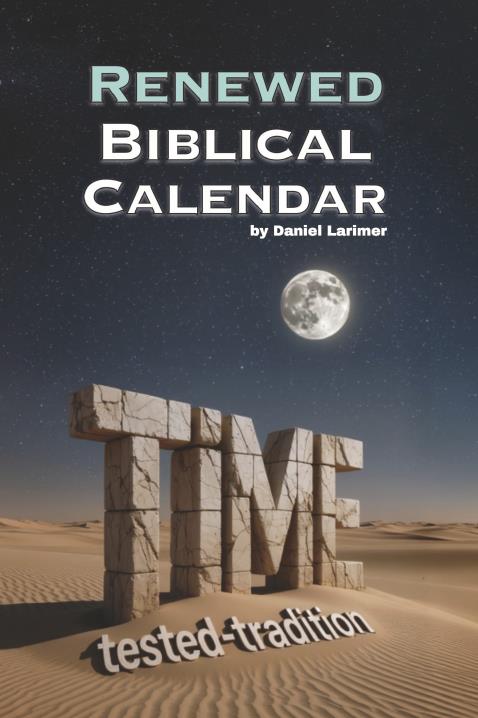
Time Tested Tradition: The Renewed Biblical Calendar (Second Edition) by Daniel Larimer is written for a simple, urgent problem: how can ordinary people keep the times God appointed when the maps we inherited may not be the map Scripture and the heavens require?
Most of us never ask. We inherit a day for rest, a method for months, and a story about the year of the cross, then assume the matter is settled. Teachers and pastors often cannot even consider another answer without risking congregation, platform, or livelihood. So the first case we heard keeps winning—until someone examines it.
This book begins with questions hard to unsee once asked. If the seventh day is a single global weekday from creation until now, how did separated peoples share one day-identity on a round earth before modern longitude and a man-made date line? If the lights were given for signs, appointed times, days, and years, why does obedience so often depend on experts, algorithms, or traditions Scripture never names as the standard? If good intentions still leave us in ignorance, what does it cost to refuse knowledge once the harder case is on the table?
Time Tested Tradition does not ask you to adopt a slogan on page one. It asks you to rebuild the calendar the way a careful case is built: fix principles of evidence first; define day, month, and year from Scripture and observable light; only then test competing week models against dated history that does not smuggle in the weekday answer in advance. The longest fights in Christian chronology—especially the year and week of the cross—often assume the Sabbath model first and shop for a year second. This book reverses that order so the terrain can judge the maps. An Evidence Outline, Glossary, and Scripture Index support fair dispute. Pastors risk platforms by asking; this book is for those who ask anyway.
Read moreDescription
Time Tested Tradition: The Renewed Biblical Calendar (Second Edition) by Daniel Larimer exists to solve a problem most readers never put into words: what if the calendar we use to honor God was inherited more carefully than it was tested?
We are told the day starts at a familiar boundary, the month by a familiar rule, the week by a continuous weekday everyone "has always known," and the year of the cross by a reconstruction that already assumes that week. History, Josephus, astronomy, and the Gospels are then asked to comply. The one who states his case first seems right—until another comes and examines him. This book is that examination.
The practical problem is obedience under real sky. Scripture presents appointed times as knowable and not too difficult. Yet popular systems often require what ordinary ancient households did not have: a fixed political date line, reliable longitude, elite calculation, or trust in a central court long after the temple fell. If two travelers circle the earth and disagree by a day, whose "seventh day" is authoritative? If the lights are for signs, appointed times, days, and years, can a map that needs modern infrastructure still be the map of Genesis? Time Tested Tradition starts there—not with a party slogan, but with physics and fairness.
The moral problem is willful ignorance. God overlooked times of ignorance; He still commands repentance. People are destroyed for lack of knowledge when knowledge is refused. Unintentional sin on the wrong day is still loss of an appointment. The book is written for those who would rather be corrected than comfortable, and who will not treat tradition as a veto over the text.
What you are invited to do is rebuild, then test. Principles of evaluation come before conclusions: Scripture sufficient, commandments not too hard, traditions that nullify the word rejected, the second case given a full hearing. Then the calendar is reconstructed in order—where a day is identified on the earth, when the day begins, when the month and year begin, how weeks are counted under the lights—using Scripture as obligation and the heavens as signs. Only after that map is on the table does the book stage the hardest historical test: fix the year of the cross from chronology that does not assume the Sabbath model under dispute, then ask which calendar produces the Gospel sequence for that year without rewriting its own rules.
That method is why someone should read this even if they expect to disagree. Many books argue for a preferred weekday and hunt a year. Fewer books refuse to let the weekday pick the year. If your confidence in Saturday, Sunday, or any inherited month rule is real, it should survive that order of proof. If it only survives by assuming the answer first, you needed this book.
The second edition is built as a reference under dispute, not only a linear manifesto. An Evidence Outline maps dependencies so you can attack one link without hand-waving the chain. A Glossary defines the working vocabulary with pointers to proof. A Scripture Index makes citations checkable. Deep chapters on Herod and related chronology exist because popular New Testament timelines are often treated as neutral facts when they are contested reconstructions. You may read in layers: spine first for the calendar case; deep chronology when you need it; tools at the back when you argue.
Second-edition material also asks a spiritual question calendar books usually skip: if the lights mark authority and appointment, what does rebellion against those signs look like in Scripture's own war language? You will find that developed in full in the chapters—not as a substitute for the calendar spine, but as pressure to take the signs seriously. An Evidence Outline, Glossary, and Scripture Index support fair dispute. Pastors risk platforms by asking; this book is for those who ask anyway.
Read more