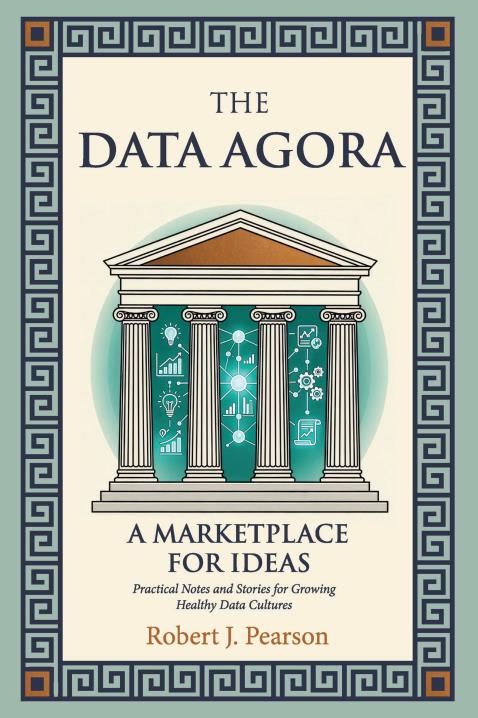


- Genre:business & economics
- Sub-genre:Consulting
- Language:English
- Pages:176
- Hardcover ISBN:9798317857868
Book details
Overview
Most data initiatives fail not because of technology but because of culture. As artificial intelligence raises the stakes for every organization, the data foundation underneath it matters more than ever. The Data Agora gives data leaders and executives a practical framework for building organizations where data actually works, and where AI can deliver on its promise. Drawing on twenty-five years of experience across several industries, Robert J. Pearson delivers ideas built on four pillars: People, the Data Product Pap, Organizational Virtues, and the Data Marketplace. Written for practitioners who have watched promising initiatives stall for reasons that had nothing to do with the tools, this is the field guide the data leadership community has been waiting for.
Read moreDescription
Most data initiatives fail not because of technology but because of culture.
Organizations spend millions on cloud infrastructure, analytics platforms, and artificial intelligence, and then wonder why the returns never materialize. The dashboards go unused. The models get built and never deployed. The data team works harder than ever and still can't get a seat at the table. The problem is almost never the technology. It is the people, the organizational habits, the absence of a shared vocabulary, and the lack of a structure that connects data producers to data consumers in a way that generates ongoing value.
As artificial intelligence raises the stakes for every organization, the data foundation underneath it matters more than ever. AI is only as good as the data that feeds it, and the data is only as good as the culture that manages it. Building that culture is not a technology problem. It is a leadership problem, an organizational problem, and ultimately a human problem. The Data Agora is a practical guide to solving it.
Drawing on twenty-five years of experience building data organizations across healthcare, technology, and education, Robert J. Pearson has developed a framework built on four pillars that every successful data culture shares.
People are the foundation of everything. The best data organizations are not built by hiring the most technically credentialed professionals. They are built by finding people with the right combination of skills, aptitude, and personality traits — honesty, curiosity, humility, grit, humor, and empathy — and organizing them into teams that complement each other's strengths. Pearson offers a practical framework for hiring, organizing, and leading data teams that goes far beyond the job description.
The Data Product Map reframes what a data organization is actually building. Most organizations treat data as a byproduct of IT operations. The data product map — built across four layers of data, user experience, business vocabulary, and technology infrastructure — positions data as something designed, maintained, and improved like any other product. This pillar gives leaders a shared language for talking about data across technical and business functions for the first time.
Organizational Virtues give data teams a vocabulary for the behaviors that determine whether an organization can actually use its data effectively. Organized across execution virtues, stewardship virtues, and mindset virtues, this framework moves the conversation beyond vague talk about data culture and into specific, actionable habits that can be observed, taught, and improved. You cannot fix a culture with a training program. You can fix it by naming what is broken and building the organizational muscle to change it.
The Center of Excellence paired with the Data Marketplace is the organizational structure that ties everything together. The CoE is not a bureaucratic oversight body. It is a small, high-functioning team that connects data producers and data consumers, builds capability across the organization, and creates the conditions for data to flow like a marketplace rather than a pipeline. When it works, it generates its own momentum. Data products get built. People use them. Trust accumulates. The flywheel spins.
This is not a research book. There are no regression analyses, peer reviewed citations, or consultant speak frameworks that dissolve on contact with reality. What you will find are honest stories from twenty-five years of data leadership, practical tools you can use on Monday morning, and the kind of guidance that only comes from someone who has been in the room when things went wrong and when things went right.
Written for practitioners and leaders who have watched promising initiatives stall for reasons that had nothing to do with the tools, The Data Agora offers flexible north stars instead of rigid playbooks. Every organization is different. The four pillars will need adaptation. The virtues wil
Read more