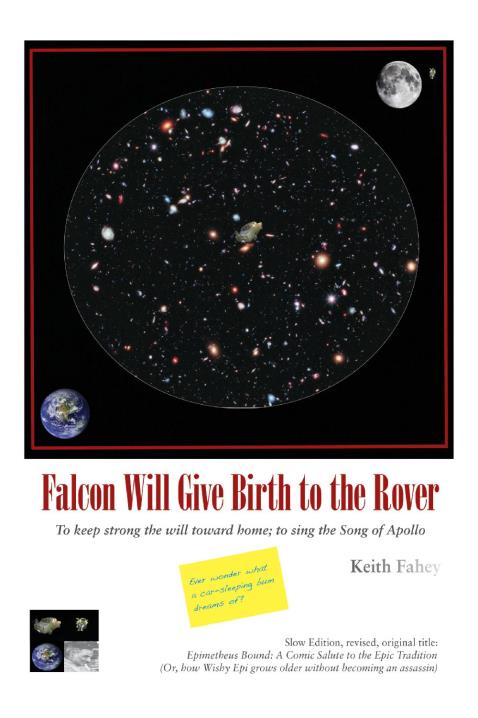

- Genre:education
- Sub-genre:History
- Language:English
- Pages:808
- Paperback ISBN:9798317848453

See inside
Book details
Overview
The 1960s and early '70s were marked by the Apollo Moon Flights and by the endless Winless War. Apollo kept alive a sense of the mythic, that Epimetheus could best understand himself and his need for homecoming by immersing himself in the epic tradition: from the Homeric poets to Vergil to Dante and on to Ariosto and other writers with epic sensibilities, all of whom prepare homeseekers for the descent into Hades. "Easy is the going down, but winning your way back, that is the labor, that the task."
The struggle has its laughs, aided by echoes of a psych teacher's basic wisdom. "So long as you can laugh at yourself, you will never go crazy; that I promise you, that I promise you."
Aided too by a sense of Dante's Pilgrim Self, who continues through the horrors of Hell and the hopes of Purgatory en route to his comic goal, the hard struggle that brings the joy of a happy end/beginning in the Paradiso.
Read moreDescription
The 1960s and early ’70s were marked by the Apollo Moon Flights and by the endless Winless War. On seeing Apollo 8 with its vision of the generous Earth as viewed from distant space, Epimetheus was struck with wonder: “If the Earth is so lovely, why do we make it so ... ugly?”
He had been drafted into the Winless War, where he was spared its worst traumas (“I won’t let this stupid war kill me”), but survival could not spare him the loss of schoolmates. Why them, not me?
If Apollo 11 touched Tranquility, Apollo 12 made a bull’s eye landing on the Ocean of Storms.
The epic tradition, and the quest for homecoming, gave Epi hope to endure. He could best understand the need for wider homecoming by immersing himself in the Homeric poets and by the slow transition to Vergil and Dante and Ariosto and other writers with epic sensibilities, all of whom prepared him for the hazards of Hades. “Easy is the going down, but winning your way back, that is the labor, that the task.”
The descent began with his decision to live in his car, a 1968 Ford Falcon. He expected admiration. Not in my front yard. Cops disrupted his nights. Resentments, hiding, embracing the psyche of a burglar, yeh, like Bilbo Baggins. Only with raging furies when cops pestered him twice too often.
You have furies of your own? This book of 727 pages with 39 pages of footnotes will distract you for a day or two. Especially if you pause to note Rollo May’s song of the furies being transformed to the Eumenides, or Workers of Grace. In daylight, when not grousing in a Stuffed-in-the-Box (“Work is hate made visible”), Epi found refuge in an air-cooled hospital cafeteria, where, with a bottomless cup of dime coffee, he immersed himself in the dime-a-day Laistrygone Winds, one of the world’s great newspapers. (Sunday’s massive leaped to a quarter.)
Hour by hour he saved clips on clips for the ultimate history he would write, reveling in the wit of Jax Myth, who found joy in the whirlwinds. And give me this day my daily Snoopy, who can wrestle the dark and stormies to the mat, by golly. O, Epi was entirely ignorant of Thoreau’s admonition, “Read not the Winds. Read the eternities.”
A few years later, in July 1971, Epimetheus (whose name means Afterthought) decided he maybe needed a new plan. He was aided by a writer’s detached hint that some people take a good idea and transmog it into something destructive. He was further moved to reconsider his planless plan by the Poet of Apollo 15, who wrote of NASA’s planned lunar descent into the Plains of Descartes.
Where your identity comes back in horror.
The command ship was called Endeavour; the Moonship was called Falcon; they were carrying an extraterrestrial vehicle called Rover. Upon landing, “A little later, Falcon will give birth to the Rover.”
A sign! A sign! The Falcon will give birth! The Falcon will give birth!
O Phoebos, you Loxian jester!
It took a while for Epi to see the joke; not till he absorbed the adverbial ambiguity: “A little later …”
Epi remembered his Psych 100 teacher: “So long as you can laugh at yourself, you will never go crazy; that I promise you, that I promise you.”
He remembered too Dr. Rollo May, who in a searching book suggested readers take setbacks in stride — less than a blip in the light of eternity.
O Far-Reaching Apollo! Is July 2026 later enough?