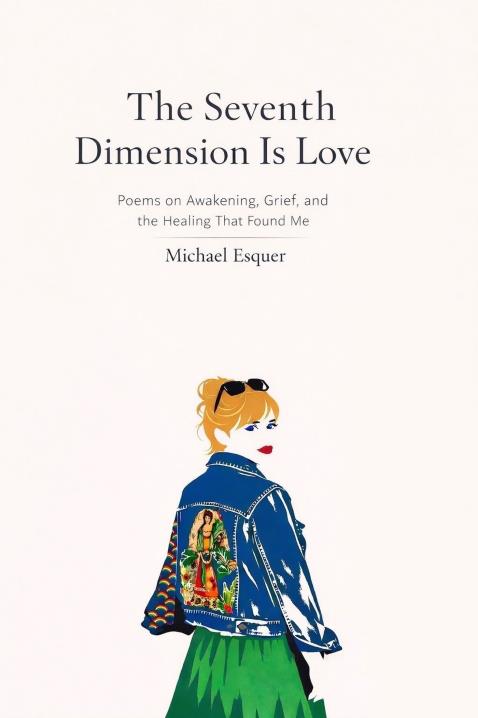
Michael Esquer is a writer and poet whose work explores love, grief, memory, and the quiet transformations that follow loss. His writing grows out of lived experience rather than literary ambition, and his voice is shaped less by formal tradition than by attention — to what is felt, what is remembered, and what remains when familiar identities fall away.
The Seventh Dimension Is Love is Michael’s first full-length poetry collection and serves as both a personal record and an offering to readers who have known deep attachment and profound change. The poems move through grief, intimacy, fatherhood, and spiritual awakening with a voice that is spare, direct, and emotionally precise. Rather than offering answers or resolutions, the work stays with experience as it unfolds, allowing meaning to arise from presence rather than explanation.
Michael is a father of five, and much of his writing is informed by the responsibility and tenderness of parenthood, as well as by the way loss rearranges one’s sense of time, purpose, and self. His poems are grounded in ordinary moments where life quietly reveals itself: a breath after grief, a memory surfacing without warning, the way light enters a room, the way love continues in altered form.
He is influenced by writers such as James Baldwin, Rainer Maria Rilke, Elizabeth Acevedo, Nikki Giovanni, and Khalil Gibran, and his work blends lyricism with moral clarity and spiritual curiosity. His poems are not performative or ornamental; they are attentive, inward, and intimate, written as much for listening as for reading. He writes with the belief that language can hold what is often lived without language, and that poetry can be a place of companionship rather than instruction.
Michael lives and writes in Texas, where he continues to develop work that bridges poetry, memoir, and meditation. His writing is dedicated to those he has loved and lost, to his children, and to anyone learning how to stand again inside a world that has changed. His work invites readers not toward certainty, but toward presence — and toward the quiet recognition that love, in all its forms, remains the deepest dimension we inhabit.