
About the Author
Louis Borbi

Author Info
Louis Borbi, the grandson of immigrants from Eastern Europe, was born in Trenton and has lived his whole life in Roebling, NJ. He grew up in a row house designated for immigrants when the town was founded in 1905. He lived in the two-bedroom house with his parents, brother, and twin sister.
After graduating from the Roebling Grammar School, Florence Township Memorial High School, and the University of Maryland, where he majored in history, Borbi taught in the Roebling Public School for twenty-nine years.
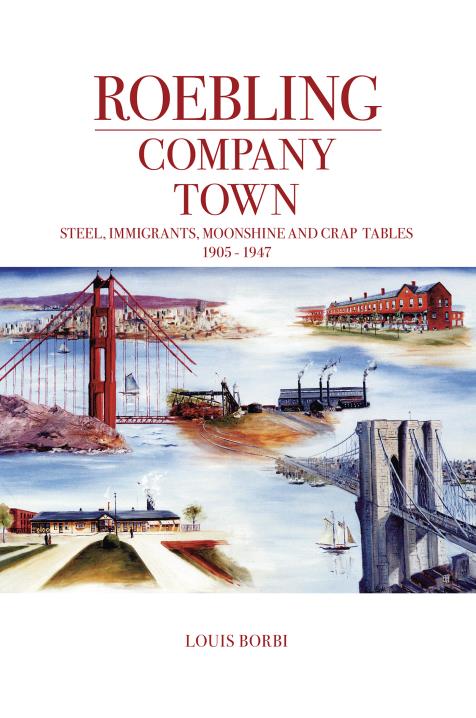
It was in his first year of teaching in 1967 that the idea for the book, ROEBLING: COMPANY TOWN Steel, Immigrants, Moonshine and Crap Tables 1905-1947, came into existence. He realized no one was documenting the stories of the men and women who worked for the John A. Roebling and Sons Company and lived in the company town. He then made a commitment to document their legacy before it would vanish forever.
For the next fifty years, he conducted hundreds of interviews in the distinct ethnic neighborhoods and barrooms, collected antiquated newspapers, magazines, old pictures, and thousands of work records. During his summer breaks from teaching, he worked in the steel plant and used his experience from working alongside the first and second generations of workers to tell their story.
As a teacher and one of the founders of the Roebling Historical Society in 1980, he brought the young generation together with the old to listen to their life experiences.
In addition, he made two trips back to the village in Romania where his grandparents emigrated in 1912. Both trips yielded a wealth of information on daily life, which in some instances, hasn’t changed much in the last hundred years.
It is Louis Borbi’s aspiration that the children, grandchildren, great grandchildren, and all future generations will read and appreciate what their ancestors contributed to the history of Roebling and our country.
News
https://www.bbc.com/travel/story/20180211-made-of-steel-how-a-new-jersey-town-rewired-history
Congratulations!
We are proud to announce that Louis recently received Preservation New Jersey's prestigious Sarah P. Fiske Legacy and Leadership Award. This is a lifetime achievement award to salute individuals who have made important and sustained contributions to the understanding and promotion of historic preservation and history in New Jersey.
Events
Louis Borbi is pleased to announce the launch of his book
ROEBLING: COMPANY TOWN
Steel, Immigrants, Moonshine and Crap Tables
1905-1947
Available in hard back and...
****COMING SOON****
Feb. 1, 2024
Available as an e-book
For more information on Roebling, please visit
Roebling Museum
100 Second Ave.
Roebling, NJ 08554
(609) 499-7200
https://www.roeblingmuseum.org
Louis Borbi, a life-long Roebling resident, educator, artist, and historian, meticulously compiled a wealth of information over the past fifty years. Read more